
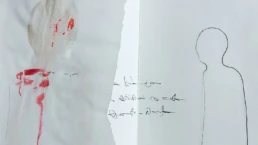
I cannot say
I cannot say
I know things I cannot say.
Nodes of information span what feels like infinite space, like a living constellation. Everything connects. Threads everywhere. It’s all there but I don’t know where to pull from first. It’s not linear, there is no hierarchy of information. Each node in itself is a world of nodes. The pieces that are missing, the imprecision of the knowing, live in the gaps.
Knowing the not knowing.
And from the nodes and threads I need to compose the sentences. But which words. What order. There are layers. How do I speak linearly in layers with words. Linear funnels the thoughts into narrowness.
The funnel doesn’t work.
I don’t work.

Not in speech. Not easily anyway. If my attention is highly attuned to something or someone outside of myself, I can articulate better. If it’s in another language it comes out awkward and my whole body recognizes, hands gesture wildly filling the gaps.
I feel like an idiot. At communicating. At being me.
How can I be an idiot at being me?
Between the constellation and the spoken words, there is processing space with a glitchy intent. It needs to hold what I’ve already said, what I’m saying now, and what I mean to say next. All at once, all moving. And when it drops, the threads split. Not the knowing. The knowing floats present. But the thoughts fall apart.
My attention dives into one node completely. Then I have to get out and find myself in the space of everything.
Where was I?
It’s not that I am slow. Nor am I confused. Well, not usually. I’m just busy translating from a space where semantics is the nemesis. What comes out of my mouth is a frayed piece of thread that doesn’t hold what I want to say.
Better I be quiet.
Better not. That isn’t me.
The fray is a piece of memory. Unreliable. The shape of a word, the feeling of a fact. A known thing standing behind me.
Only I can’t turn around.
And it whispers.
I can feel the breath of it, but not the words. They’ll come. They usually do. The next day when I’m brushing my teeth. Some such thing.
I wish people saw the machine inside me. Saw how the gears don’t understand the why in how they are forced to work.
But they see the delay. My awkward way with words. Or they see nothing because I recede into the quiet me. Not worth the effort of the words.
Writing is better. I have more time. I have no one waiting. No pressure. My attention is peaceful. I can come back to it. Sometimes I write for me. A place to put my thinking. Sometimes I write for others. Carefully. And free to take time with the frays weaving threads into form. Slow. But peaceful there.
I have a memory and language challenge with my AuDHD (Autism and ADHD). We can call it difference, but it feels like deficit. Unless I’m speaking with others who have language floating inside their skulls like mine — a version of orbiting textures and shapes. Or something different. But the same.
Double Empathy. When I’m with someone of similar brain architecture, communication happens from within the knowing. With ease. No translation required. No rules.
To be seen, to be understood like that — is rare. And it’s beautiful.
As I’m writing this essay, I realize the book I’m writing speaks of constellations, threads, and navigating through space. Nothing to do with language or the essay topic. It’s the dream world of a fictional character. Yet there I am, my process reflected in my character’s unrelated-related process.
“I’m in the sea but there’s no sea. Constellations float ahead, North Star pointing the way. I need to navigate through this field of stars, all connected by threads. It’s a game or a trick of some kind…I’m guided in by an outside force. This might not have been a good idea. It could be a black hole. I’m traveling inside a theory of strings. I feel lost, my gut clenching, my lungs in my throat. I can scream but I can’t breathe. My scream strums the threads between the stars like I’ve plucked the strings of a guitar. Everything ends.”


Love in Solitude
Love in Solitude
My previous essay led me to the solitude I know, and know to return to. It helped me think out some things, but it felt unfinished.
What happens to solitude when someone else enters?
__
I grew up with solitude. Partly context, partly my nature. I spoke to the moon, found friendship in flowers, and learned that cats were my people. I learned early I could be my own company, in a world of wonder.
Then I married. And I learned what solitude had been protecting me from.
I left my marriage when I was 32. It was the beginning of choosing myself. A difficult road lay ahead, but it led my son and me somewhere good, somewhere meaningful. I wanted to know who I would become without the constraints of a life not for me. I wanted my son to witness that in the woman who raises him.
Be true to yourself, I wanted him to know.
As shown, not as told.
Being married to a man ill-equipped to see me, or to understand my world, never mind love me, had not been the way.
The absence of relational safety with men over the years deepened my solitude. I chose men who came with unspoken conditions attached. I sought approval.
I would have to be someone I was not.
Be true.
With years of therapy, trauma work, and the gradual unmasking of a self that had been suffocating under decades of layered adaptation — so woven into my being there had been no room to breathe, to be — something emerged. Each new breath was relief, grief, and fear of the unfamiliar.
I took my space.
Thank you, solitude.
Once I had taken my space, I met someone who offered relational safety in a romantic context. It was different this time. What I noticed was my solitude did not diminish. It became the ground for something I hadn’t experienced before with a man: genuine co-regulation.
My nervous system did what it cannot do alone. It co-regulated. It settled not only from within but also between, on shared ground. No diminishment of myself. Just two people, each capable of their own company, choosing not to be alone. Each seeing the other clearly.
The choosing matters. And it complicates things in a way that took time to fully feel.
Relational safety, unlike solitude, is contingent.
Solitude, once found, travels with you. It asks nothing of anyone else. Relational safety depends on the other person remaining present; on context, or circumstances neither control. The nervous system knows this. Every genuine intimacy carries risk. Not as pessimism, as simple fact. To be with someone is to be inside the possibility of a goodbye.
The nervous system carries what it has learned. That safety associates with aloneness or unpredictability. That love and loss are structurally linked. This is not abstract. It lives in the body as a bracing that resurfaces even in the presence of someone safe. An old prediction before the new evidence registers.
Found solitude is not the opposite of relational safety. It is its necessary infrastructure. Without real internal ground or the capacity to return to oneself when the contingency of intimacy makes itself felt, relational safety becomes something to cling to rather than something to inhabit.
My nervous system still reaches before it remembers. I have said goodbye.
The goodbye lives in me still, unresolved. I let it live. But underneath is something steady. The self that exists independent of whether it is witnessed by another.
I am intact.
This love did not exist to fill an emptiness or to comfort fear. It existed with the fullness of a self that has learned to be at home in its own company.
If love returns, it won’t feel like bracing for pain.
It will feel like recognition.
Me and another. With love between.

On Victimhood and Responsibility
On Victimhood and Responsibility
Capacity, Power, and the Erasure of Context
A response to the way the language of responsibility is used to silence rather than clarify.
Twenty years ago, at a time when I was barely holding myself together, the person I trusted most told me to stop acting like a victim.
His words sank in like a cold blade, silenced any instinctive defiance I may have had, and shame set in in its place. My lived experience was marked as a flaw of character, my pain reframed as my own error.
I spent years struggling with the embodied residue of that shame.
The idea that we are responsible for what happens to us is often presented, in popular moral discourse, as a form of empowerment, a sign of maturity or strength. But this framing relies on the false assumption that people always have meaningful access to choice.
They don’t.
Choice is shaped by conditions. When the system you are inside, the relationship you are embedded in, or the nervous system you are inhabiting constrains what is possible, responsibility cannot be neutral.
To proclaim otherwise is to confuse a moral preference with a contextual reality.
Treating harm as a failure of personal responsibility misunderstands how survival and coercion actually work.
Victimhood is not an identity.
It is a position.
By victimhood, I mean being located, sometimes briefly, sometimes repeatedly, in conditions where power, safety, or agency are limited.
Oppression operates through social realities that determine whose suffering is legible and whose is dismissed. These realities are not equal, and they are not imagined. In some worlds, harm is named. In others, it is minimized, normalized, or reframed as personal failure.
Victimhood, in this sense, is not weakness. It is context.
Context matters.
I had no awareness of my neurodivergence until just a few years ago. I did not understand that much of my lived experience was shaped by AuDHD and CPTSD. I had no framework—internal or social—for what was happening in my nervous system. My lack of language or understanding for this at the time did not reduce the reality of what I was going through.
This dynamic is not unique to neurodivergence. It appears where fear, dependency, coercion, or asymmetry negate agency and limit choice.
Clarifying capacity does not erase responsibility where it exists; it prevents responsibility from being falsely assigned.
In my context, I was not choosing poorly. I was in blind survival mode, and survival is not a choice; it is a constraint.
My perception was saturated. Emotional and sensory input entered without a filter. My body understood endurance, not rest or reflection. Meaning was fractured because capacity was overwhelmed. I had been pushed, for as long as I knew, to survive in an environment that shames limitation according to dominant social standards. I was isolated in a dense fog of confusion, self-blame, and fear—with the resulting distress treated as a failure of character rather than genuine lived experience.
Misinterpretation can be dangerous.
I recall connecting deeply to a poem years later by Alejandra Pizarnik. Words from a place I knew. A place once shamed for existing.
La muerte siempre al lado.
(Death is always at my side.)
Escucho su decir.
(I listen to her words.)
Sólo me oigo.
(I only hear myself.)
— Alejandra Pizarnik
(translation mine)
Being told to “stop acting like a victim” can utterly negate the urgency of a system under strain stating its limits. It can be the body signaling that it is at the edge of its capacity. Feeling like you are standing on the edge of a cliff with the abyss on one side and life on the other is generally terrifying for a reason. Dismissal does not produce resilience; it accelerates collapse. Compassionate attention opens possibility. The opposite of shutting down.
Naming this does not deny agency; rather, it locates where and when agency is actually available.
Harm is frequently a function of power. Reducing harm to individual failure conveniently obscures these dynamics. Power is relational, situational, and unevenly distributed across a spectrum of realities.
Responsibility for harm lies with the person or the system that caused it.
Responsibility after harm is different. It isn’t about rewriting the past to make suffering appear avoidable, nor about absolving oneself or others. Nor is it about assigning endless blame. It is about responding to consequences that were not chosen, once safety and capacity begin to return.
Accountability, in this sense, means:
- telling the truth about what happened
- allowing the impact to be real
- refusing to internalize another’s actions
- reclaiming agency as it becomes available
The safety for reclaiming agency requires honesty—about power, about harm, and about cost. Without honesty, “responsibility” becomes performance and the strain of self-negation continues.
In other words, when people are told to take responsibility too early, what is often demanded is not growth but containment—containment in the service of the convenience and comfort of others.
This is compliance, not accountability. Western culture praises resilience, but often only when it is quiet, efficient, and non-disruptive. For a long time the resilience word itself gave rise to anger in my bones. I’ve since adopted a more organic contextually-rooted understanding of the word so I can work with it again.
Responsibility cannot begin where experience is denied. It cannot grow in a body still bracing for threat. And it cannot emerge from shame. Shame only narrows capacity.
There are victims. This is a fact of unequal power, constrained choice, and lived bodies. Denying this does not restore agency; it relocates blame. Acknowledging this does not negate agency; it anchors agency in reality. It is a precondition for responsibility.
Anything else is not empowerment. It is erasure—of context, of harm, and of the conditions under which agency can return.

Unmasking, Slowly
Later-in-life awareness or diagnosis has been on my mind. My own lived experience with late-diagnosed AuDHD is part of this, alongside the newness of unmasking I witness in my work and community.
At the start, a sense of urgency can hit hard. Awareness arrives and suddenly feels like a demand — something that must be addressed immediately. But we don’t step out of an alien suit and instantly become who we are “meant” to be.
The self inside has been isolated and is likely burned out by chronic stress. Complex trauma is commonly part of the picture. The emerging newness needs time to adjust, to grow, and to orient.
If I could speak to the younger, masking version of me, I would say: I get it. I understand. I cry for you, and it hurts. And thank you, because you helped me survive. I’m here now, and I’m learning to be okay.
Slowly.
Alongside relief, grief tends to surface, along with a sudden recognition of just how much effort has been involved. The monitoring. The adjusting. The rehearsing. The hiding.
What is usually meant by “masking” is the largely unnoticed effort of adjusting oneself to fit a context. Monitoring tone or expression. Managing reactions. Anticipating expectations. Explaining or simplifying oneself. Suppressing responses that might disrupt a situation. It is a learned strategy for navigating social, professional, and relational environments. Over time, it can become a form of self-erasure.
Through sustained and compassionate awareness, however, something else begins to happen. A sense of self begins to breathe.
The self emerges.

This is what takes time. It takes pacing, and attention, and practice with the unfamiliar experience of being yourself in the world. That unfamiliarity can feel destabilizing.
But the question can shift from Who am I? to something quieter and more precise:
What in me needs time?
Notice how the first question carries pressure and the second invites listening.
Our attention is easily pulled toward immediacy, toward change that happens quickly and visibly. But movement that happens too fast can introduce its own form of threat to a system already in transition. Nervous systems need time to learn. They need space to build capacity without overextending themselves in order to appear “normal” by society’s narrow standards.
Unfamiliar territory often feels unsafe. Awareness may take us there, but slowness allows us to meet our capacity where it actually is, leaving room not only for safety, but for joy and connection.
“Safety is not the absence of threat; it is the presence of connection.”
— Gabor Maté
Safety is contextual, relational, and temporal. Some environments can hold more variance. Some cannot. Learning this distinction takes time. It often begins with noticing where effort increases and where self-monitoring accelerates. Allowing a reaction to exist internally without reorganizing it. Letting a thought pass without translating it into something more acceptable.
Over time, these moments of awareness accumulate, and a clearer sense of what feels costly and what feels sustainable begins to form.
Unmasking does not require explanation. It does not require making inner experience legible to others.
Sometimes unmasking looks like doing slightly less. Sometimes it looks like leaving earlier. Sometimes it looks like continuing to mask because the context calls for it. What matters is not whether a mask is present, but whether its use is reflexive or chosen, rigid or flexible, unconscious or aware.
Unlearning coexists with relearning, and with learning for the first time. Some transformations are visible. Others happen quietly, almost imperceptibly over time, with space, rest, and relief from demands.
Safety to emerge.
Being "Better"
“Better”
Feel better, do better, be better.
“A word is a small witness, but it carries the trace of how we have learned to see.”
— John Berger
Recently, someone close to me said they wanted to be “a better person.”
My thought was: just be.
Not because I don’t believe in growth or transformation, but because the reflex to become “better” can pull us away from the person we’re already in the process of becoming. The word sounds innocent enough, yet it can quietly shape how we see ourselves. There is an evaluative, authoritative quality to “better” that doesn’t always align with the helpfulness people think they’re offering.
I sense the weight of “not enough” — conformity disguised as motivation.
“Better” often refers to a more regulated, more manageable version of us. A version shaped by external expectations and by the nervous-system adaptations we learn to stay acceptable or safe.
Growth isn’t self-correction. Just be — and in being, we become…

“Just being” is not stagnation or passivity. It’s choosing connection over performance. It’s the space where growth emerges organically rather than through self-vigilance.
Sit with the word “better” for a moment. What is felt? Comparison, direction, judgment?
Once you bring attention to the word, it becomes clearer. Something more specific surfaces — something precise, intimate, human — a desire for clarity, safety, coherence, or alignment.
Attention turns “better” into something you can be with, instead of something to chase.
We talk about being better at communicating, better with boundaries, or better at staying composed as if the measurement exists somewhere outside ourselves. But what we’re describing is internal — a certain clarity, a deeper read on what is surfacing, a more coherent place to respond from.
“Language is a map, but not the territory. We mistake one for the other at our own cost.”
— Olga Tokarczuk
“Better,” when used without attention, can become a map that points toward a socially sanctioned ideal rather than the actual landscape of our lived experience.
Cultural expectations
Contemporary Western culture reduces the word “better” into something more regulated, productive, consistent, agreeable. A refined self. A disciplined self. A version of you who doesn’t disturb anyone.
I’d rather disturb.
“Better” becomes a way to signal conformity, without depth, without complexity, without the fullness of being human.
For those of us who have spent years masking or managing our nervous systems to appear steady, appropriate, or easy, “better” can feel like an old survival strategy resurfacing.
Be easier, be steadier, be smoother, be less.
No thank you.
Improvement defined from the outside narrows possibilities.
Improvement defined from within, reveals it.
The cost to creativity
Inner life and creative process move similarly: both open when we aren’t inhibited by expectation, when we are listening to what is happening within.
“Better” doesn’t inspire originality; it confines imaginative space to evaluation. Creativity doesn’t respond to pressure, comparison, or internalized evaluation. It responds to contact, attention, and the courage to be true to the work as it emerges. The creative process embraces uncertainty and messiness. It embraces growth, experimentation and intuition. Judgement replaces curiosity, leading to staying safe rather than staying true.
Work will evolve and refine as one becomes more attuned, more honest, more willing to let the work become what it needs to become rather than what you think it should be by comparison to outside standards.
Stop the focus on “better” and what happens? Possibility opens.
In place of “better”
Ask: what am I noticing that I don’t yet have language for?
“We interpret ourselves through the words we have.
Change the words, and you change what becomes possible.”
— Adrienne Rich
If “better” is the only concept available, your possibilities narrow into striving, correcting, and performing…
Shift that framing: What’s really happening? What’s becoming clearer? What feels more accurate than before?
Let pressure dissolve into attention.
Ask: what softens? what sharpens? what stops making sense? what becomes impossible to ignore? These are the kind of questions that connect you with actual becoming.
Self-development is noisy. Inner life isn’t.
When you stop negotiating with an idealized version of yourself, you can begin to listen to what is really there. You can listen to what is being asked of you from the inside.
Just be.